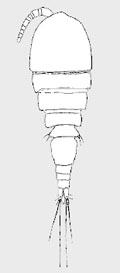
The genus Metacyclops is widespread in tropical and temperate regions, being most prolific in European, African and South American regions, poorly known for North America and Australia. However, both the stygobiont and surface copepod fauna of Australia is presently actively investigated, and first results of these researches (Karanovic, 2003, 2004; Pesce et al., 1996; Pesce & De Laurentiis, 1996; De Laurentiis et al., 1997; Mercado-Salas et al.,2013) are revealing a rich assemblage of species in this area.
At present the genus includes more than 62 valid species and subspecies, most of them recorded in different groundwater habitats, such as wells, caves, anchialine habitats.
Metacyclops, as many other genera in the subfamily Cyclopinae [Muscocyclops Kiefer, 1937; Speocyclops Kiefer, 1937; Apocyclops Lindberg, 1942; Menzeliella Lindberg, 1954; Cochlacocyclops Kiefer, 1955 (= Metacyclops?); Goniocyclops Kiefer, 1955; Teratocyclops Plesa, 1981; Hesperocyclops Herbst, 1984; Fimbricyclops Reid, 1993; Graeteriella Brehm, 1926] has a proximal segment of leg 5, usually indicated by a remnant seta, partially or entirely fused to the somite, and a distinct distal segment with two appendages (Kiefer, 1927, 1929; Reid, in press). Among the above genera, Metacyclops is characterized by antennula 9-13, exceptionally 17-segmented, rami of the swimming legs 1 to 4 always 2-segmented, and free segment of leg 5 armed with one short spine and one, generally long, seta distally implanted.
Lindberg (1961) established two species-groups within the genus, viz. the minutus-group and the gracilis-group, embracing species characterized by one or two distal appendages on the endopod 3 of leg 4, respectively. In the same paper the Author divided the males of Metacyclops into two groups. viz. those with a leg 6 with three appendages, and those with the same leg bearing only two appendages. Herbst (1988, 1990) provided useful, updated World keys of the species.
The most recent review of the genus, with World distribution of species, was provided by Reid (1991). Later on, Rocha (1994) pointed attention to the presence of different patterns of integumental pores on the urosomites, as well as to other additional useful characters in the taxonomy of the genus. Pesce et al. (1996), as well, pointed out particular spinules pattern on the basipodite of the antennule, both in males and females.
"Recent taxonomic works (Herbst
1988, Reid 1987, 1991, Fiers 2001, Karanovic 2004a, 2004b) recognize four groups
based on the spine formula of the terminal exopodite segment of legs 1-4 (designated
as spine formula of legs 1-4). The first group, with a 3443 spine formula contains 52 of
the 62 species of the genus. The second (3442) and third (3433) groups each contain
one species, M. mortoni Pesce, De Laurentiis and Humphreys, 1996 and M. cushae
Reid, 1991 (syn. Pseudohesperocyclops Brancelj et al. 2024) , respectively
B - Species with spine formula: 3 4 4 2
C - Species with spine formula: 3 4 3 3
D - Species with spine formula: 3 3 3 3* *trispinosus-group, according to Karanovic (2004)
At present, the species M.grandis Kiefer, 1935 (Uruguay) cannot be placed in any of these groups since in the original description the author did not report the above spine formula.
Most species and subspecies belong to the first group (A). Within this group the species can be distinguished by numerous other characters, such as the number of articles of the female antennula, presence/absence of vestigial exopodal seta on the proximal article of the antenna, the armature of the coxa of legs 1 to 4, the number of distal appendages on the endopod 3 of leg 4, the length of furcal rami and the ratio between inner and outer apical furcal setae, the length ratio spine/seta on the exopod of female leg 5. As regards this last character the following species can be separated since they are characterized by a very short seta and a rather long spine on the exopod of female leg 5, as well as they show a 11-segmented antennula and 2 apical spines on the distal segment of leg 4 endopod.
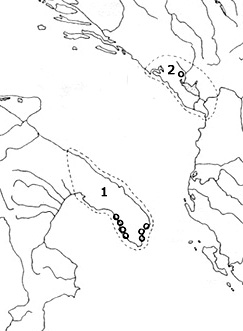
* The spine formula of this species is not reported in the original description by Kiefer; spine formula "3443" observed in specimens recently collected by Pesce et. al. from the type-locality (unpublished), and by Karanovic (1999) in material from Montenegro. The presence of this species in Corsica, Sicily and and Sardinia (Dussart & Defaye, 1985) is questionable (Karanovic, 1999). M. stammeri is one of the Tertiary relicts that survived Quaternary cyclic periods of ice ages in subterranean habitats. Its present distribution (fig. on the right) is most probably the consequence of the last ice age which drived it into two refuge areas [Salentine Peninsula, south Italy (1) and Skadar karstic valley (2)]. [after Karanovic (1999)]
** The spine formula of this species is not reported in the original description by Kiefer; spine formula "3443" pointed out by Pesce (1978) in material from Greece and by Jaume (1990) in specimens from Balearic Islands; Por (1993) illustrated a leg 2 exopod 3 with only 3 spines in specimens of the same species from Israel. Our recent examination of some specimens from the type locality confirmed a spine formula "3443" for this species (unpublished).
The second group (B) harbors only the recently described M. mortoni Pesce et al., 1996 The group "C" includes M. cushae Reid, 1991 (Lousiana, U.S.A., Honduras, Brazil; natural and artificial fresh waters, wells)
Four taxa fit the group "D" (Mercado-Salas et al., 2013) As regard M. margaretae, notwithstanding the different spine formula of the exopod 3 of legs 1 to 4, and other minor differences, Lindberg (1961) and successively Monchenko (1975), Dussart (1969) and Dussart & Defaye (1985) considered this species synonym of M. gracilis. However, in my opinion, and according to Defaye (in litt.) and Mercado-Salas et al. (2013), the two species can be considered as distinct taxa.
ATHIBAI , WONGKAMHAENG &
BOONYANUSITH, 2022. European Journal of Taxonomy 787: 146–181
1 Applied Taxonomic Research Center and Department of Biology, Faculty
Two new species of Metacyclops Kiefer, 1927 (Copepoda, Cyclopoida)
from Thailand and an up-to-date key to the species recorded in Asia
BOONYANUSITH et al., 2018
A new genus and two new species of cave-dwelling cyclopoids
(Crustacea, Copepoda) from the epikarst zone of Thailand
and up-to-date keys to genera and subgenera
of the Bryocyclops and Microcyclops groups. European Journal of Taxonomy 431: 1–30
BOZCURT A. 2021. First Record of Metacyclops subdolus Kiefer, 1938 (Copepoda, Cyclopidae) from Turkey. Acta Aquatica Turcica. 17(1), 78-87 (2021)
A. BRANCELJ, C. BOONYANUSITH & L.SANOAMUANG,2024.
A new cyclopoid genus (Copepoda, Crustacea) from a deep aquifer
in northeastern Thailand with comments on peculiar sampling sites
and local fauna.Raffles Bullettin of Zoology 72: 71-83. 2024. WALTER T.C. & BOXSHALL, G. (2021). World of Copepods database. Metacyclops Kiefer, 1927. Accessed at: https://www.marinespecies.org/copepoda/aphia.php?p=taxdetails&id=347484 on 2021-06-04
DEFAYE D. 1992. Metacyclops hannensis n. sp. (Crustacea, Copepoda,Cyclopoida), un cyclopide nouveau du Senegal. Rev. hydrobiol. trop., 25 (2):145-151.
DE LAURENTIIS P., G. L. PESCE & W. F. HUMPHREYS. 2001. Copepods from ground waters of Western Australia, VI. Cyclopidae (Crustacea: Copepoda) from the Yilgarn Region and the Swan Coastal Plain. Humphreys, W.F. and Harvey, M.S. (eds).
Subterranean Biology in Australia 2000. Rec. West. Austr. Mus., supp. n. 64:115-131
GALASSI D.M.P. & G.L. PESCE. 1994. Metacyclops geltrudae n.sp., a new cyclopid from ground waters of Venezuela (Copepoda, Cyclopidae). Crustaceana, 67 (3): 284-287.
HERBST H. 1988. Zwei neue Metacyclops (Crustacea Copepoda) von den Westindischen Inseln Barbados und Aruba: M. agnitus n.sp. und M. mutatus n.sp. sowie ein Bestimmungsschlussel fur das Genus. Bijd. Dierk., 58: 137-154.
HERBST H. 1990. Metacyclops janstocki n. sp. (Crustacea, Copepoda) von Antigua (Westindische, Inseln).
Beaufortia, 41 (11): 75-81.
ISHIDA T. 1995. A new species of Metacyclops (Crustacea, Copepoda, Cyclopoida) from Ishigaki Island, the Ryukyu Islands. Proc. Jap. Soc. Syst. Zool., 54:33-37.
KARANOVIC T. 1999. First record of Metacyclops stammeri Kiefer, 1938 from Balkan Peninsula. Spixiana, 22 (3):193-198.
KARANOVIC T. 2004. The genus Metacyclops Kiefer in Australia (Crustacea: Copepoda; Cyclopoida), with description of two new species. Rec. West. Aus. Mus., 22: 193-212.
T. KARANOVIC, S. M. EBERHARD and A. MURDOCH. 2011.A Cladistic analysis and taxonomic revision of Australian Metacyclops and Goniocyclops, with description of four new species and three new genera (copepoda; Cyclopoida)
MERCADO-SALAS N.,SUAREZ-MORALES E., MANDEA-MARTINEZ A, SILVA-BRIANO M., 2013. A new species of Metacyclops Kiefer, 1927 (Copepoda,
Cyclopidae, Cyclopinae) from the Chihuahuan desert,
northern Mexico. ZooKeys 287: 1–18 (2013)
PESCE G. L., 1978. The occurrence of Metacyclops subdolus Kiefer (Crustacea:Copepoda) in subterranean waters of Greece, with remarks on its systematic status. Int. J. Speleol., Amsterdam, Olanda, 10 (2): 179-183
PESCE G. L., P. DE LAURENTIIS & W.F. HUMPHREYS. 1996. Copepods from ground waters of Western Australia. I. The genera Metacyclops, Mesocyclops, Microcyclops and Apocyclops (Crustacea Copepoda:Cyclopidae). Rec. West. Austr. Mus., 18: 67-76.
LINDBERG K. 1961. Remarques sur le genre Metacyclops (Kiefer, 1927) et description d'un Metacyclops nouveau du Portugal. K, fysiogr. Sallsk. Lund. Forh., 31: 133-145.
REID J.W. 1987. The cyclopoid copepods of a wet campo marsh in central Brazil. Hydrobiologia, 153: 121-138.
REID J.W. 1990. Metacyclops leptopus totaensis, new subspecies (Crustacea:Copepoda) from Lago de Tota, Colombia. Proc. Biol. Soc. Wash., 103 (3): 674-680.
REID J. W. 1991. The genus Metacyclops (Copepoda:Cyclopoida) present in North America: M. cushae, new species, from Louisiana. Journ. Crustacean Biol., 11 (4): 639-646.
REID J.W., J.A. MOLINA AREVALO & M.M. FUKUSHIMA. 1990. Metacyclops leptopus totaensis new subspecies (Crustacea:Copepoda) from lago de Tota, Colombia. Proc.Biol. Soc. Washington, 103:674-680.
ROCHA C.E. F. 1994. New species of Metacyclops (Copepoda, Cyclopidae) from Brazil, with remarks on M. campestris. Zool. Script., 23: 133-146.
FIERS FRANK
HERBST H.V.
ISHIDA TERUO
KARANOVIC T.
PESCE GIUSEPPE L.
REID JANET W.
ROCHA CARLOS E. |