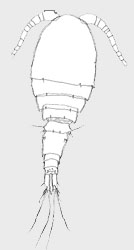
| CYCLOPINAE Kiefer, 1927
CRYPTOCYCLOPS G. O. Sars, 1927 (=MICROCYCLOPS Claus, 1893) 
Cryptocyclops anceps (Richard, 1897) (= Microcyclops anceps (Richard, 1897)
Cryptocyclops anninae (Menzel, 1926) (= Bryocyclops anninae (Menzel, 1926)
Cryptocyclops assimilis Sars G.O., 1927 (=Microcyclops assimilis (Sars G.O., 1927)
Cryptocyclops attenuatus (G.O. Sars, 1909) [Africa; lakes] (syn. (Microcyclops attenuatus (Sars G.O., 1909)
Cryptocyclops bicolor bicolor (G.O. Sars, 1863) [cosmopolitan, except Australia; fresh waters]
Cryptocyclops bicolor breviramus (Fryer, 1957) [Malawi; fresh waters]
Cryptocyclops bicolor transactor (Plesa, 1981) [Cuba; ground waters]
Cryptocyclops caudatus G.O. Sars, 1927 [Africa; fresh waters]
Cryptocyclops brevifurca Lowndes, 1934 (syn. Neutrocyclops brevifurca (Lowndes, 1934)
Cryptocyclops caudatus G.O. Sars, 1927 [Africa; fresh waters]
Cryptocyclops crassipes Sars G.O., 1927 (= Microcyclops crassipes (Sars G.O., 1927)
Cryptocyclops diminutus (Lindberg, 1937) [Asia; fresh waters]
Cryptocyclops elongatus Lowndes, 1934 (= Microcyclops elongatus (Lowndes, 1934)
Cryptocyclops exiguus (G.O.Sars, 1909) [Africa; Madagascar; lakes]
Cryptocyclops falsus (Kiefer, 1926) [Africa; fresh waters]
Cryptocyclops gemellus (Gurney, 1928) [Africa; lakes]
Cryptocyclops inchoatus Shen & Sung, 1965 [China; fresh waters]
Cryptocyclops inopinatus Sars G.O., 1927(= Microcyclops inopinatus (Sars G.O., 1927)
Cryptocyclops intermedius Shen & Tai, 1964 [China; fresh waters]
Cryptocyclops javanus Kiefer, 1930 [China, Java; fresh waters]
Cryptocyclops kentanensis (Harada, 1931) [China, Formosa; fresh waters]
Cryptocyclops laticornis Lowndes, 1934 (= Microcyclops laticornis (Lowndes, 1934)
Cryptocyclops levis Kiefer, 1952 [Africa, Zaire; fresh waters] *
Cryptocyclops linjanticus (Kiefer, 1928) [Africa, Madagascar, Portugal, Fiji, Yemen; fresh waters]
Cryptocyclops longiarticulatus Shen & Tai, 1964 [China; fresh waters]
Cryptocyclops mendocinus (Wierzejski, 1892) (= Microcyclops mendocinus (Wierzejski, 1892)
Cryptocyclops nyasae (Fryer, 1957) [Malawi; lakes]
Cryptocyclops symoensis Kiefer, 1956 [Tanganika; lakes]
Cryptocyclops rubellus (Lilljeborg, 1901) (= Cyclops rubellus Lilljeborg, 1901
Cryptocyclops symoensi Kiefer, 1956 (= Microcyclops symoensi (Kiefer, 1956)
Cryptocyclops tanganicae (Gurney, 1928) [Tanganica; lakes]
Cryptocyclops tredecimus Lowndes, 1934 (= Metacyclops tredecimus (Lowndes, 1934)
Cryptocyclops tricolor (Lindberg, 1937) [Asia; fresh waters]
Cryptocyclops uviramus Kiefer 1958 [Tanganika; lakes]
Cryptocyclops varicans (Sars G.O., 1863) (= Microcyclops varicans (Sars G.O., 1863)
FIMBRICYCLOPS Reid, 1993
The genus is distinguished from other members of the family Cyclopidae, subfamily Cyclopinae, by the combined characters of the antennule of the female having 11 articles, the antenna lacking an exopodite seta, the mandible with the palp represented only by 1 seta, the maxilliped having 4 articles and a reduced number of setae on articles 1, 2, and 4, the biarticulate rami of legs 1-4, the leg 5 with the proximal article fused to the somite and the distal article broader than long, and the peculiar somitic ornament consisting of rows of spines on the lateral surfaces of the posterior prosomites and the posterior hyaline membranes of the anterior 2 (in the female) and 3 (in the male) urosomites modified as a spinous fringe. Leg 6 of the male bears 3 plumed appendages of which the medialmost is spiniform and most thickly set with stiff spinules (from: Reid, 1993).
Fimbricyclops jimhensoni Reid, 1993 [Puerto Rico; bromeliads]
FIERSCYCLOPS Karanovic, 2004
KIEFERIELLA Lescher-Moutouč, 1976
Kieferiella delamarei (Lescher-Moutoué, 1971) [France; ground waters]
GONIOCYCLOPS Kiefer, 1955
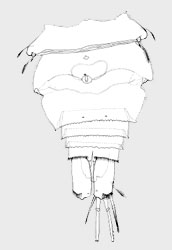 | | | |
Goniocyclops alter Kiefer, 1955 [Madagascar; psammon]
Goniocyclops arenicola Dussart, 1984 [New Caledonia; lakes, interstitial]
Goniocyclops mortoni Karanovic, 2004 [Australia]
Goniocyclops primus Kiefer, 1955 [Madagascar; psammon]
Goniocyclops silvestris Harding, 1958 [New Zealand; fresh waters] (left)
Goniocyclops uniarticulatus Karanovic, 2004 [Australia]
|
HYPOCYCLOPS Fiers, 2012
Hypocyclops kieferi (Petkovski, 1971)
Hypocyclops montenegrinus (Karanovic, 2001)
DUSSARTCYCLOPS Karanovic et al., 2011
Dussartcyclops (Dussartcyclops) mortoni (Karanovic, 2004) [W-Australia; ground waters]
Dussartcyclops (Dussartcyclops) uniarticulatus (Karanovic, 2004) [W-Australia; ground waters] ]
Dussartcyclops (Barrowcyclops) consensus (Karanovic, 2003) [W-Australia; ground waters] ]
IDIOCYCLOPS Herbst, 1987
Idiocyclops stocki Herbst, 1987 [Barbados; wells]
| PAGE UPDATED AUGUST 29. 2023
Copyright © 1999-2023 G. L. Pesce - All Rights Reserved. Text and images on this website may not be
redistributed or put as part of any collection (image archives, CDs etc) without prior written permission
   |
|